
Identical production demand does not imply an identical backup problem. One factory may face brief interruptions with regular charging opportunities, while another loses supply for extended periods with limited alternative generation. The task assigned to commercial energy storage solutions changes with those conditions. Defining the available supply, the interrupted duties and the opportunity to restore stored energy gives the project a clearer starting point than a battery-capacity figure alone.
Describing the Supply Problem Before the Equipment
Interruption frequency, outage duration and the condition of the available supply describe different aspects of grid availability. A site may experience complete loss of power, disturbances while power remains present or a combination of both. Those events need identifying separately because they do not present the same requirement to connected equipment.
Production records add the consequences of those events. An interruption during an idle period differs from one that stops an active process or leaves essential supporting equipment unavailable. The relevant description joins the electrical event to the activity affected, so the storage duty reflects the actual factory operation rather than a broad label of unstable supply.
Disturbances while power remains available need a separate description. A production total cannot establish whether a lost period involved an interruption or an unsuitable supply condition, so event descriptions and electrical observations provide different kinds of evidence.
A requirement for commercial energy storage solutions also needs to identify other available sources. Existing solar generation, a compatible generator and the times when the utility supply returns can change the reserve that must be retained. Availability means a source can serve the intended duty under the relevant conditions, rather than merely being present on the site.
Recognizing What the Stored Reserve Can Cover
A battery can support supply only within its usable energy, power and connection limits. Covering a short interruption is a different duty from maintaining production through a long outage. The required operating period must correspond to the retained factory activities, with any reduced-production or shutdown sequence identified as part of that period.
Repeated interruptions introduce a recovery problem. A reserve partly used during one event may not be fully restored before the next, particularly when the available charging period is short. Assessing a sequence of interruptions therefore requires attention to both discharge and recharge opportunities, even if each individual outage appears manageable when considered alone.
Returning utility power may coincide with equipment restarting. The planned charging contribution then joins the operating load at the connection point, so a recovery schedule needs to account for both duties rather than treating the returning supply as unrestricted.
The electrical connection also determines the duty that can be carried. Operating voltage, frequency, the retained distribution arrangement and the intended transition between supplies all belong in the assessment. Storage is one part of that arrangement; its presence alone does not establish that every supply disturbance falls within the installation’s operating limits.
Relating Factory Conditions to an Integrated Configuration
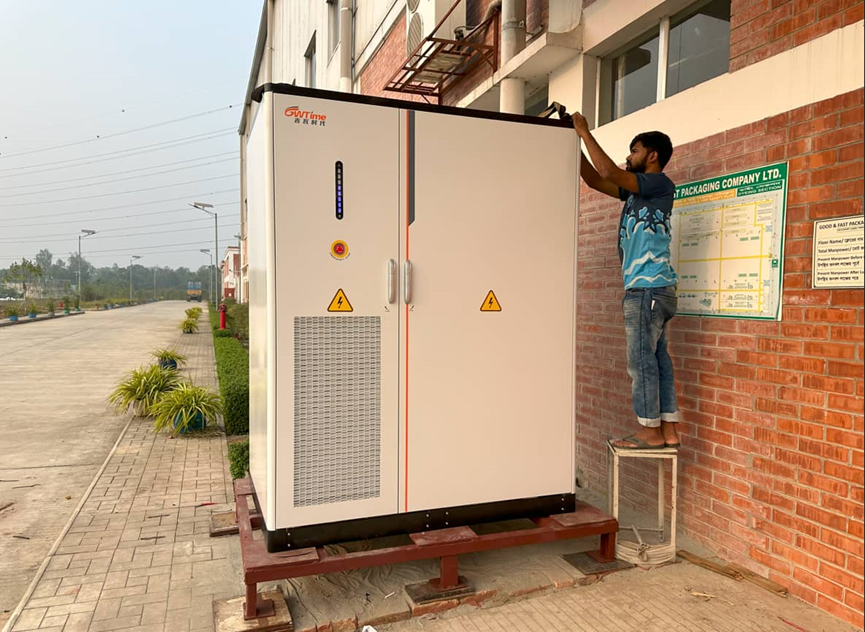
If the retained duties fit the applicable 125 kW operating capability, the GWTime all-in-one[1] family provides a configuration reference with 225 kWh or 257 kWh of nominal battery energy. Factory wiring brings its conversion, battery, control, transfer and distribution equipment together within the integrated cabinet before installation. The reference establishes equipment functions for a defined duty rather than coverage of an unspecified factory.
The associated DC-coupled architecture connects solar generation through external MPPT controllers to the DC side. Battery storage provides energy shifting and backup capacity, while conversion equipment connects the energy path to the AC duties. Whether solar can restore the required reserve depends on the actual resource and load, so the array connection is not itself proof of sufficient charging opportunity.
Generator coordination adds another possible supply path where a suitable generator is available. In prolonged low-solar conditions, the DC-coupled operating sequence can start diesel generation when battery charge reaches the minimum threshold. The threshold defines a handover condition, but the project’s generator availability and configured integration remain part of the intended reserve strategy.
Choosing the Operating Priority That Fits the Grid
A factory with dependable charging periods can assign storage a different routine duty from a site protecting a scarce outage reserve. Under suitable grid and tariff conditions, a discharge schedule may target demand periods. Where supply is unreliable, preserving or recovering the energy needed for essential operation can become the more pressing task.
Reserve recovery has an explicit mode in the GWTime DC-coupled solution. A preset low state-of-charge threshold initiates battery-priority charging from available sources, including solar or the grid, until the target charge is restored. That sequence makes source availability a necessary part of the recovery plan, especially when utility supply is intermittent.
The operating priority for commercial energy storage solutions also has a control-authority dimension. In dispatch-command mode, GWTime equipment follows charging and discharging instructions from an upstream EMS at the relevant power port. Establishing who issues those instructions helps define the intended operating arrangement, rather than assuming that every available mode runs independently at the same time.
The stated project objective needs to remain tied to the factory’s supply problem. Interruption records, retained duties, available generation and recovery opportunities together define the reserve’s job. Grid availability determines what that reserve is for, as well as when the energy used during an interruption can be restored.
全文出现较多all-in-one,但查找只有三处加了连字符,其余未加。建议统一格式,比如作定语统一加连字符
